



We’re back with new findings from the Working Class Project, the largest research effort in Democratic politics dedicated to understanding the working class electorate, where they stand on the issues, and what Democrats need to do to build back a working class coalition.
Earlier this month, we launched a new survey of working class voters across the battleground, part of our longitudinal look at how these voters are shifting. We’ve been talking to these voters since the start of 2025, tracking their movements on key issues and how they’re feeling about Donald Trump, Republicans, and Democrats heading into November. The poll, conducted in September by GBAO, surveyed 1,000 registered working class voters. This group voted Trump +7 in 2024, but our findings point to increasing unpopularity for Trump and Republicans among these voters — a hopeful sign for Democrats, if they can capitalize on this movement in the final stretch in the midterms.
Key Findings
Across almost every measure, the environment has worsened for Trump and improved for Democrats.
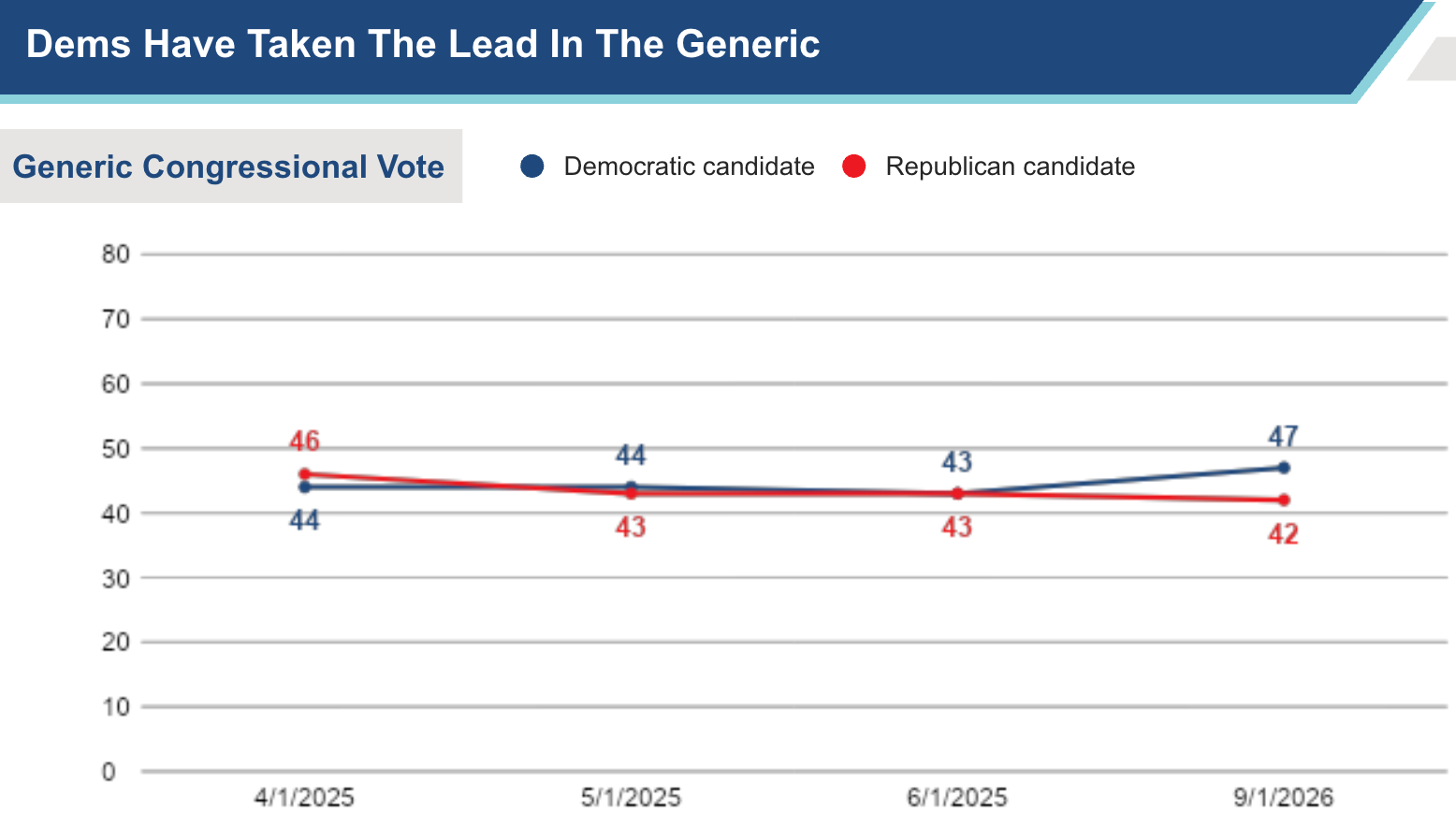
Democrats are leading on the generic ballot +5, up from -2 in April last year.
Democratic messaging consistently performs better than Republican messaging, with voters more worried about Republicans’ failure on lowering costs or reigning in corruption than culture-war attacks on issues like the border and transgender athletes.
Working class messaging focusing on costs, hard work, or corruption all have broader appeal than either blowing up the system or being a moderate.
Working Class Voters Are Turning On Trump, And He’s Taking Republicans Down With Him
When we first polled working class voters in April 2025, Trump’s favorability numbers were nearly split: 49% viewed him favorably, 50% unfavorably. Since then, that gap has significantly widened. Today, just 41% hold a favorable view of him, while 59% see him unfavorably.
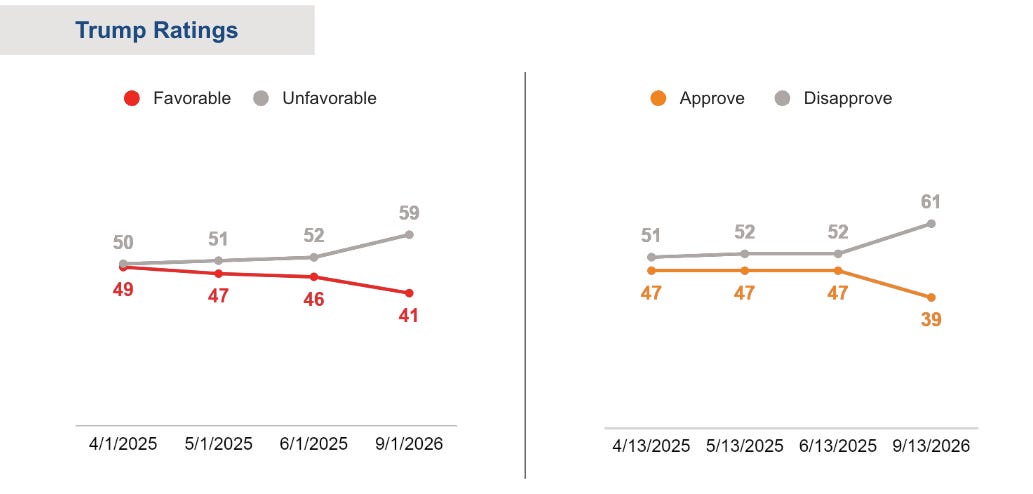
Even starker, 1-in-5 Trump 2024 voters polled now say they regret their vote for president. That regret is most prevalent among Latino voters (29%) and voters under 40 (26%), key demographics that Democrats lost ground with in 2024.
But it’s not just Trump who is sliding in favorability with these voters. Trump’s unfavorability is dragging Republicans down, too. Just 39% of working class voters view Republicans in Congress favorably, a -6 difference from last April when 45% held favorable views.
Working Class Voters Are Feeling Things Get Worse, Not Better
Underneath Republicans’ waning popularity is working class voters’ feeling that they are worse off. Compared to last year, more working class voters today say they are financially worse off now than they were six months ago, up to 46% from 39% in April of 2025. Even more of these voters are pessimistic about where the country is headed, with 64% saying the country is on the wrong track today, compared to 55% last year.
That pessimism is largely being driven by the economy. Working class voters are feeling strained by an economy where costs are only rising and they feel their hard work isn’t being rewarded, and they’re shifting away from Trump and Republicans because of it. The earlier benefit of the doubt that working class voters told us they were extending to Trump and Republicans in our focus groups is fading, and is now replaced by growing disapproval.
Democrats Are Gaining Ground On Working Class Issues, While Republicans Are Losing Ground On Issues They Used To Own
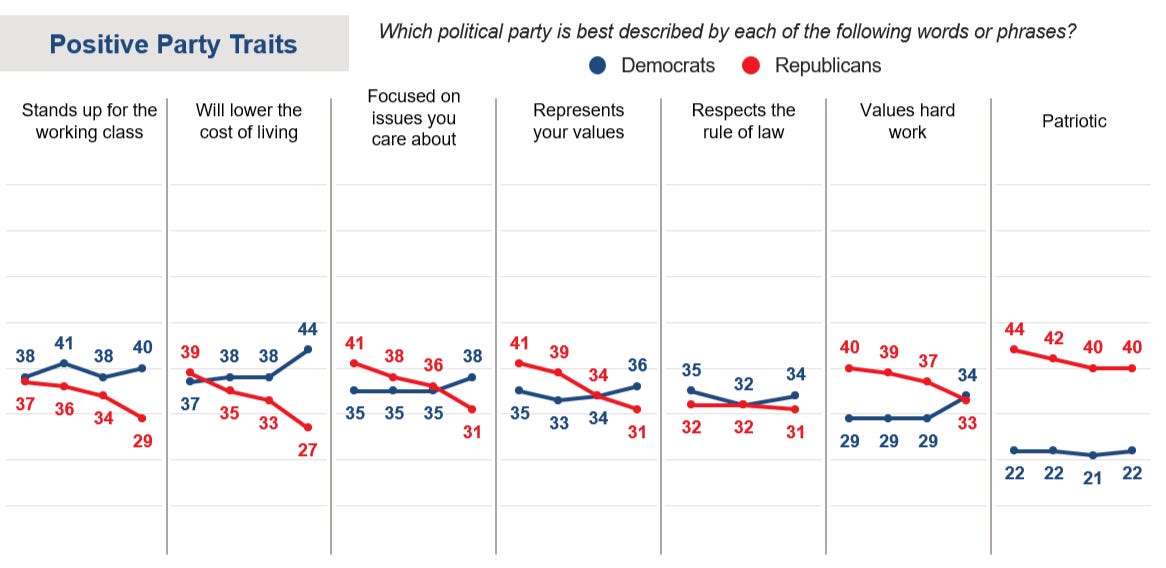
After the 2024 election, Republicans held an advantage on many of the major party traits that mattered to these voters. They were seen as better on lowering costs, standing up for the working class, and focusing on the issues that mattered to them. Today, that perception has flipped. Democrats are now leading by double digits on many of the traits that Republicans were ahead on just last year.
Asked now which party they expect will lower the cost of living, Democrats have pulled ahead of Republicans by +17 points, and +28 points among Independent voters. That’s a major shift from just last year, when working class voters in our poll gave Republicans the lead by +2.
On which party “stands up for the working class,” Democrats are ahead +11 overall, +18 with Independents. Democrats are also now seen as the party more focused on the issues working class voters care about, leading +7 today, compared to -6 last year.
Meanwhile, working class voters increasingly see Republicans as “too close to wealthy special interests” (-27 overall, -33 with Independents), being “controlled by the most extreme elements of their party” (-13 overall, -16 with Independents), and more corrupt than Democrats (-12 overall, -21 with Independents).
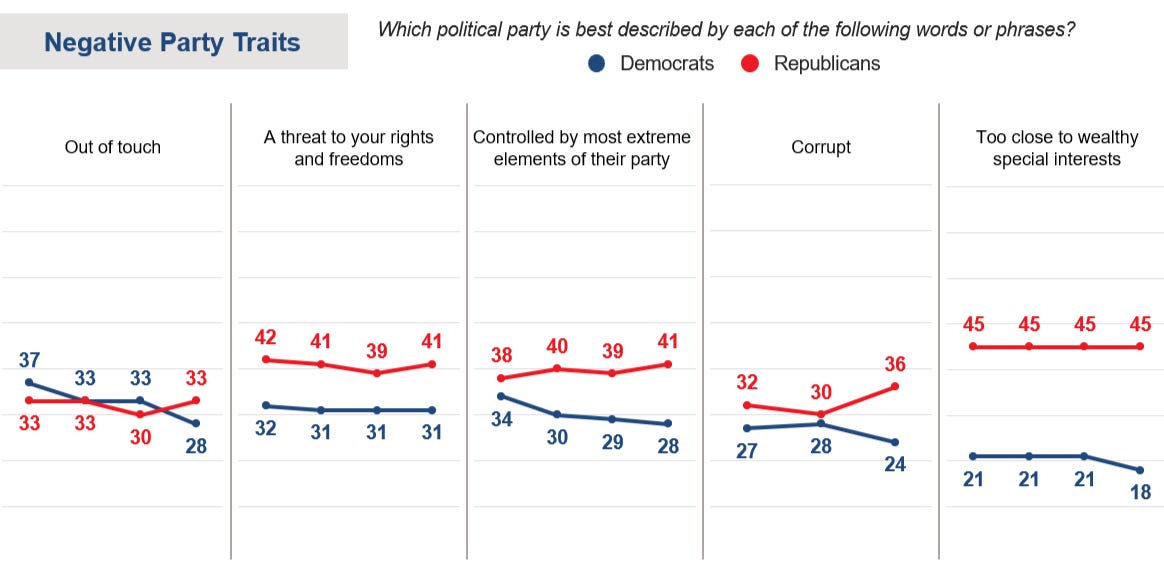
Across our focus groups, we’ve seen corruption and special interests become increasingly salient issues with these voters, especially as they’ve continued to make the connection between corruption and their own higher costs. These perceptions about Republicans’ corruption and their coziness with wealthy special interests represent major liabilities for them, and opportunities for Democrats to drive that narrative home.
Democrats Lead In The Generic Ballot Test
Democrats are also seeing major improvements on the generic ballot test, a hopeful sign less than two months out from the midterm elections. Democrats now hold a +5 edge over Republicans on a generic congressional ballot, a +7 improvement from April of last year when Democrats were sitting at -2. The biggest swings were among independents (-3 to +18), white non-college voters (-25 to -14), and even Trump 2024 voters (-82 to -72).
The Most Effective Messages
Democrats lead +5 in a generic ballot, but our polling shows Democrats have an opportunity to pull even further ahead — by as much as double digits — when the right messaging is employed.
Among the messages tested, focusing on cost of living and our economy rewarding hard work were the top performers in shifting the ballot even more in Democrats’ favor. Both of these messages resonated more than messaging focused on overhauling the entire system.
Cost of Living (+11): The Democratic candidate says our economy is struggling and costs are out of control. Hard-working Americans are stretching every dollar, trying to afford groceries, gas, utilities, and medicine. Car trouble or one trip to the ER could push them over the edge. If we stand up to big corporations and the politicians in Washington who serve them, we can support working families by cutting middle class taxes, lowering health care costs, and cracking down on price gouging.
Hardwork (+12): The Democratic candidate says, too many politicians have lost sight of the value of hard work. Our economy should reward those who work hard to get ahead and play by the rules. Standing with people who work hard for a living means helping Americans keep more of what they earn and build a secure retirement. Every American, regardless of where they live, should have access to quality, affordable health care and good schools for their kids.
Overhaul (+9): The Democratic candidate says, out political and economic systems are broken, with politicians focused on using their position for their own gain, trading stocks with insider information and lining their own pockets while working families struggle to make ends meet. We need to overhaul the system so that politicians work for the people who elect them, starting with term limits for all members of Congress, a non-partisan audit of all federal government spending, and banning members of Congress from trading stocks.
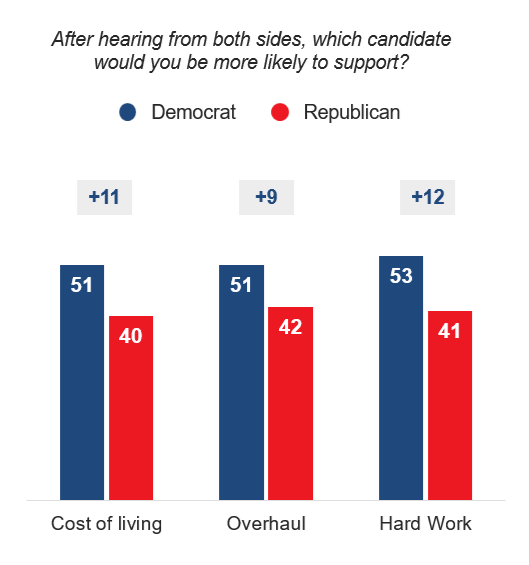
Voters agree that the system needs major change (62%), but very few think it needs to be torn down completely (12%). The candidates and messages that focus on cost of living and rewarding hard work outperform the ones that call for a complete overhaul of the system.
Corruption And Costs Beat Culture War
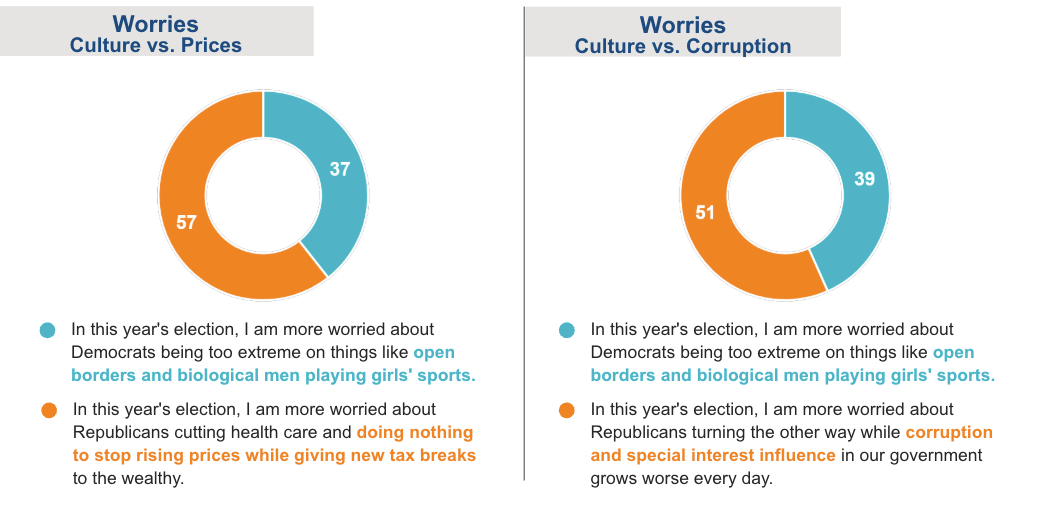
When we asked voters what actually worries them, the answer wasn’t culture war issues, it was higher costs and corruption.
57% of voters polled said they were more worried about Republicans cutting healthcare, doing nothing to stop rising prices, and giving new tax breaks to the wealthy, compared to just 37% who said they were more worried about Democrats being too extreme on things like open borders and transgender athletes. Similarly, voters are more concerned about Republicans letting corruption run unchecked (51%) than Democratic extremism on the same cultural issues (39%).
Working class voters are worried about the issues that impact their own bottom line every day. They respond more to candidates who focus on corruption and who demonstrate working class roots and understanding than they do candidates who share their same views on culture war issues or who focus on moderating themselves.
What This Means For Democrats
The cost of living and an economy that rewards hard work are what move these voters. They’re looking for leaders who understand that they are struggling to keep up, and have a real plan to bring costs down. Democrats who stay disciplined on working class messages, rather than focusing on culture wars and calls to throw out the whole system and start over, are the ones best positioned to capitalize on Republicans losing ground.
But this also comes with a reality check. Our polls show a shift away from Republicans, but that doesn’t necessarily translate to enthusiasm for Democrats. Democrats’ favorability still sits underwater at -10. It’s a 7 point improvement from July of last year, and a 7 point edge on Republicans’ favorability, but it still represents limited excitement for Democrats among this electorate.
These voters are persuadable, and a decent share of them have buyer’s remorse with Trump and Republicans. The environment has turned hard against Trump, and that’s created a real space for Democrats to make gains with these voters this November. But building a long-term winning coalition with these voters for 2026 and beyond requires continuing to re-build trust with them. That means continuing to show Democrats are listening to these voters and employing the messages that resonate with them, relentlessly focusing on lowering costs and standing with working families.
Watch American Bridge Co-Chair Mitch Landrieu and GBAO principals Margie Omero and Karl Agne discuss the latest findings and what they mean for Democrats:
With the looming concerns of seating Democrats-elect after the November midterms, I would encourage that this be teed up for messaging. Affordability and democracy work hand-in-hand. Essentially, you can't establish the programming without a functioning government.
"They respond more to candidates who focus on corruption and who demonstrate working class roots and understanding than they do candidates who share their same views on culture war issues or who focus on moderating themselves." What was specific finding on this? How did you measure?