

Working Class Weekly: Georgia On My Mind

We’re back this week with new findings from the largest research effort in the Democratic Party to understand how working class voters are thinking about the 2026 midterms — and what Democrats need to do to earn their votes.
Over the last few weeks, we’ve recapped our discussions with the same group of Trump voters we talked to last year, as well as focus groups in the battlegrounds of North Carolina and Iowa.
Today, we’re talking about the great state of Georgia, where we went in early May.
Georgia is critical for the Senate. Incumbent Democratic Senator Jon Ossoff is defending a seat in one of the most closely watched battlegrounds of the cycle. There’s also a key race for Governor and other statewide races that will be important for the 2028 map and beyond.
We held two focus groups: working-class white Georgians, ages 21 to 39, and working-class Black Georgians, ages 25 to 64. The white group leaned independent. The Black group was a mix of Democrats and independents — and critically, people who are not definite to vote in 2026. Understanding why they might stay home is as important as understanding what would bring them out.
Here’s what we found.
NOT JUST UNHAPPY, “SCARED”
In Iowa, working-class voters described the country as “a hot mess.” In Georgia, the language was even more fearful. Scared. Worried. Numb. Disappointed. Embarrassed.
Where Iowa voters felt squeezed, many Georgia voters described something closer to free fall. The lone “hopeful” participant in the room clarified, when asked, that she was being aspirational — not describing anything she was actually experiencing right now.
The distinction matters. Squeezed voters are looking for relief. Voters in free fall are looking for someone who even understands that they’re falling.
“Save from what?”
In past focus groups across many states, working-class voters have lamented that they can’t afford vacations, can’t save for retirement, can’t get ahead. That’s still true — but in Georgia, we heard something more severe. These voters weren’t talking about vacations. They were talking about the basics of survival.
One participant described what a $20 buffer in her budget would mean: it would be tough to find. Another described spending $500 a month on groceries as a single person — without luxury items — and being unable to explain why. A newly single mother described spending roughly half her take-home pay on gas, unable to afford daycare for her one-year-old, unable to qualify for an apartment because she doesn’t earn three times the monthly rent. She put it plainly: “When you don’t make that, what are you supposed to do?”
A white voter who had to downsize from a three-bedroom house to a two-bedroom apartment just to keep pace with bills wasn’t describing a setback. He was describing an ongoing renegotiation of what his life is going to look like — and not by choice.
Democrats looking for economic messages that connect in Georgia don’t need to manufacture urgency. The urgency is already there. They need to meet people where that urgency lives.
Trump gets Ds and Fs — but the reasoning differs by group
Trump’s grades in Georgia were dramatically worse than what we saw in Iowa. Not a single white voter gave him above a D. Among Black voters, two gave him a B and a C respectively — but their explanations were telling: they didn’t see him as performing well, they saw him as simply revealing the truth about America. As one put it, “he’s the face of the ugly truth.” Another said he’s “really letting us know how it is.” For these voters, Trump isn’t an anomaly. He’s a symptom.
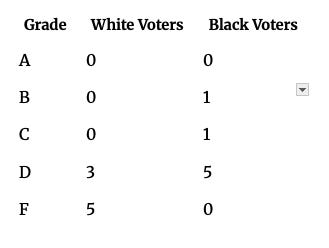
White voters gave Trump Fs for broken promises — on inflation, on war, on the fundamental direction of the country. One described him as having “succeeded in making very few things better, and instead, making everything worse.” Another compared his use of executive orders to every other president she’s had complaints about — before adding that she was more worried about the cabinet around him than about Trump himself.
That last observation is worth flagging. Voters who focus anger on the system around Trump, rather than Trump alone, are not going to be satisfied by messages that are purely Trump-centric. They need to see accountability attached to specific people making specific choices.
When we shared Trump’s own words describing the economy as “strong” and in a “golden age,” the reaction was immediate and visceral. “He’s delusional,” said one. “It makes me mad,” said another.
A Black voter offered a careful translation of what she thought Trump meant: the golden age is real — for Elon Musk and the billionaires. For the average person, it’s not.
“I feel like the Golden Age probably refers to his friends or people he knows, like Elon Musk and the billionaires and stuff. It probably is like that. But for the average person, it’s not.” — Black voter
“I’m sure he doesn’t feel the effect on it. Because he’s Donald Trump, you know, he’s had plenty of money his whole life. He doesn’t know how we actually live... It’s not just him personally, it’s anybody in the government. I don’t feel like they truly care.” — White voter
This is the same dynamic we saw in Iowa: Trump’s economic denialism isn’t just wrong, it’s insulting. It converts broader economic frustration into a specific, personal grievance.
HEALTH CARE IS A LIFE OR DEATH EMERGENCY.
Iowa voters described insurance costs and coverage gaps as painful and infuriating. In Georgia, we heard something different in scale. These are not voters frustrated by high premiums. These are voters whose family members are being actively harmed by what’s happening to Medicaid right now.
One white voter described driving an hour to the nearest hospital because her local one had closed. She has two children. One ambulance in her area, she said, because there’s no funding. Her mother is in the CCU with lung cancer complications — and was told her Medicaid had been cut. Her sister, mid-cancer-treatment, was cut off as well. Her sister’s port hasn’t been flushed in nine months.
This is not a focus group quote about a policy preference. It’s a description of a family experiencing a health care crisis in real time, right now, because of decisions made in Washington by Trump and the Republican congress.
Black voters responded to the health care messages with moral outrage that matched the white voter’s personal experience. Cutting hospitals. Cutting ambulances. Eliminating essential services for the least fortunate. Several called it evil. One asked the question that stopped the room:
“If people can’t afford to send their kids to school and feed them and get health care, everybody’s going to die — and then what are you fighting for?”
In the message testing, health care was the dominant choice in both groups. The strongest message combined corruption and health care in one frame.
TAX FAIRNESS AND OTHER MESSAGES EFFECTIVE
As we’ve seen consistently in April and May, our “tax cuts for the wealthy while cutting benefits for the rest” frame landed across both groups, though it worked differently. White voters responded to it as a moral outrage — cutting Medicaid and food assistance to fund breaks for corporations that “aren’t worried about food, aren’t worried about health.” Black voters responded similarly, framing it as a question of whose lives the government has decided to value.
The stock trading ban message — so powerful in Iowa, particularly with men — landed more softly in Georgia. The reason was revealing: several participants simply said they don’t follow stocks and don’t invest, so it didn’t feel relevant to them. When you’re figuring out whether you can find a spare $20, the machinations of a congressional stock portfolio feel very far away. The principle of congressional self-dealing matters to these voters. The mechanism of insider trading doesn’t resonate if you’ve never had money to invest.
The lesson for us here lies in crafting a corruption message that can be translated into the concrete terms of these voters’ actual lives.
Social Security rises to the top — and it’s not just about retirement
The strongest non-cost message overall was about a Republican who supported raising the Social Security retirement age and slashing social security administration funding. Seven of fifteen participants chose it. This surprised some in the room, given the relatively young age of the white group. But it shouldn’t surprise us. Working-class people think about Social Security not just as their own future retirement — they think about their parents, their grandparents, anyone they’re already helping support.
“Like, it is just like, Gosh, what a lot of societies really, really prioritize the elderly, and we, I just, it’s just sickening to get to that point in your life and think you have something and it’s completely stripped from you when you’re not able bodied.” - white woman
When SSA offices close and wait times spike, the people answering those phones for elderly relatives are often the same working-class adults sitting in our focus groups.
A message about spending on the White House ballroom also reached seven total because it underscores that while you can’t afford gas and groceries, the president is spending hundreds of millions of dollars to renovate his own party space.
Abortion was chosen by five participants, led by white voters. It continues to be a durable vulnerability, particularly when framed as part of a broader pattern of Republicans taking away personal freedoms and choices.
Redistricting: the mobilization message Democrats are underleveraging
Here’s a finding that deserves serious strategic attention ahead of 2026.
Black voters in Georgia raised redistricting and voter suppression organically, without significant prompting, and connected it directly to their willingness to participate in elections. Several specifically named the 2018 Governor’s race as a moment of betrayal — when their votes were not fairly counted, when the rules were designed to sideline them. One described losing faith in the ethics of the electoral system entirely when redistricting started happening around him. Another said it directly: “Those whose votes should matter... their votes don’t count because they’re being thrown away.”
The message we tested about a Republican who used power as Secretary of State to purge nearly half a million names from Georgia’s voter rolls, nearly half of them Black, was chosen by four participants, driven by Black voters. It speaks to something much deeper than a policy preference. It speaks to a foundational question of political belonging: does my participation in democracy actually count?
For the Black voters in our group who are not definite to vote in 2026, this is a key mobilization lever. These voters are not cynical about democracy in the abstract. They’re cynical because they have specific, concrete reasons to believe their votes have been taken from them. Meeting that cynicism with specificity, naming what happened, naming who did it, and making a case for why it matters to show up anyway, is not a generic GOTV message.
WHAT WE’RE WATCHING
Georgia is not Iowa. The economic distress is deeper. Health care costs and coverage will be a central issue this fall, and winning campaigns to reach working class voters will tell the story about what’s happening to real families right now. The political disillusionment, particularly among Black voters who have watched their voting power be systematically undermined, also runs deep.
The path to winning requires both persuading skeptical white working-class voters and mobilizing Black voters who have real and specific reasons to question whether their participation changes anything.
Both tasks are achievable but neither is inevitable. We’ll keep watching as campaigns get fully underway in the Peach State.
NEXT WEEK: We look at the top negatives moving working class voters in focus groups across the battleground we tested.
It is heartbreaking to hear what is happening in ordinary American lives. We need a lot of big bold ideas to begin to turn this around. We are exploring a tax reform and civic conversation that may help unburden America.
Can you edit the profile summary? Should that read 2029, not 2025?