

Working Class Weekly: How Campaigns Are Using Working Class Messaging To Offer A Different Path Forward

Last week, we examined how Democrats are using working class messaging to power their campaigns. Across the country, campaigns are messaging relentlessly about costs and corruption — putting health care cuts, special interests, and self-dealing at the forefront of their messaging. Campaigns are tapping into the working class ethos, communicating on the issues and values that our project’s research shows resonates with voters.
Our research also reveals a clear mood among these voters: growing frustration with Republicans’ priorities — driven primarily by the war in Iran and its associated costs.
This week, we’re continuing to look at how campaigns are using working class messaging — highlighting how Democrats are using resonant messaging to turn Republicans’ priorities into a liability, while offering voters a compelling forward vision for the future.
THE WRONG PRIORITIES
As we’ve shared, working class voters are fatigued and feeling betrayed. Our research finds them frustrated with the war in Iran, which they see as the opposite of what this administration promised. Even the most Trump-leaning participants believe he has the wrong priorities, and the war is the one of the central reasons why.
These voters experience the war primarily as an economic issue, burdened by the higher costs at home and the taxpayer dollars spent abroad. Democrats and allied groups are honing this, tying that frustration with Republicans’ priorities directly back to costs. They’re drawing a direct line between the war and the higher costs working class voters are facing — and the issues at home that aren’t being addressed because of the war’s price tag.
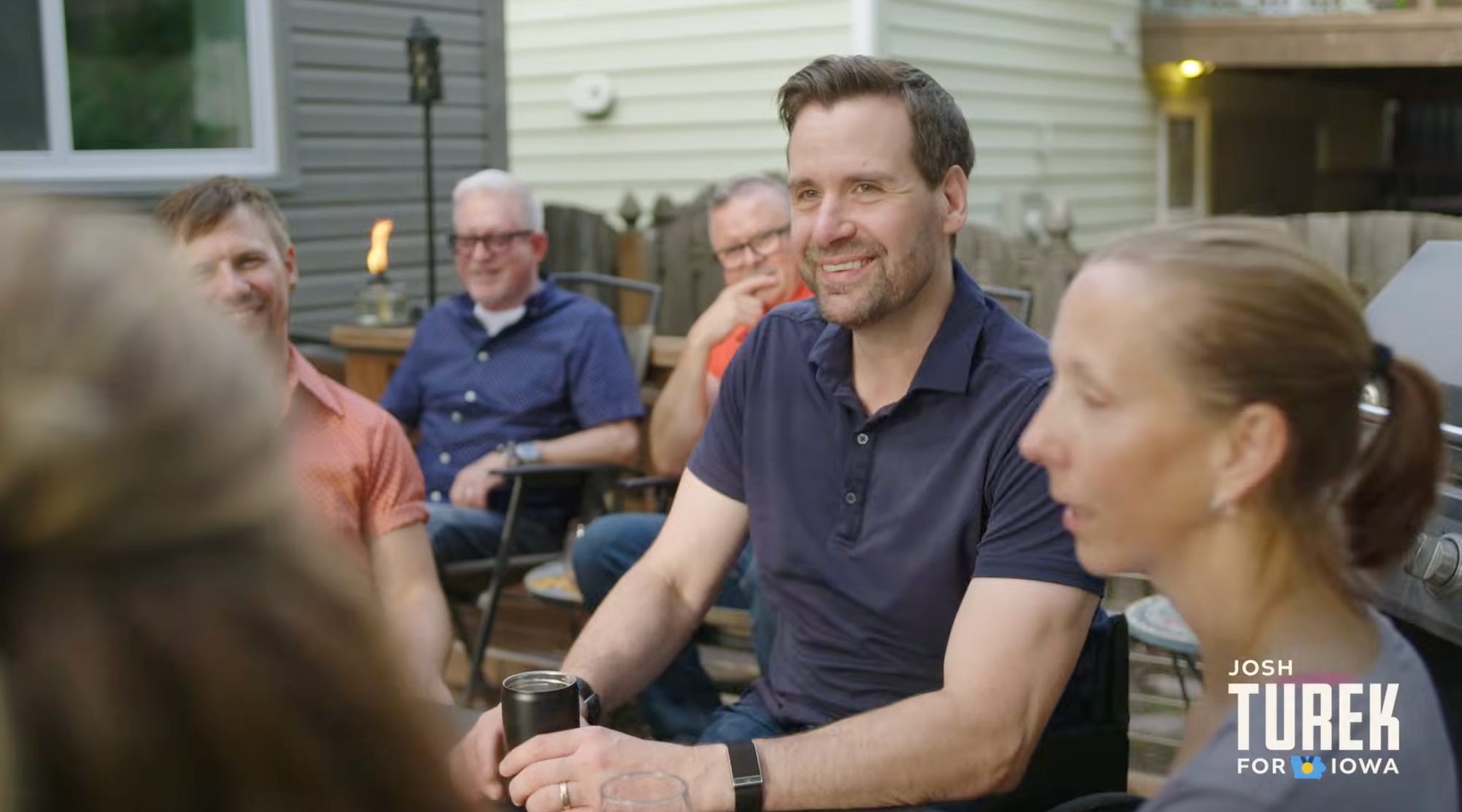
In Iowa, Senate candidate Josh Turek is drawing on his own life story to message about the Iran war and make the case of Republicans’ wrong priorities. In a campaign ad, Turek frames the issue around affordability, telling working-class voters directly: “It’s working class families like mine paying the price for Trump’s war and Washington’s corruption.”
Born with spina bifida because of his father’s exposure to Agent Orange while fighting in Vietnam, Turek has used numerous public appearances to emphasize his own background as proof that these foreign conflicts have consequences that last generations. He ties it directly to kitchen table issues, hammering the point that Washington is writing blank checks for wars abroad while health care, schools, infrastructure, and the cost of living at home go unaddressed.
VoteVets, a Democratic-aligned group who supports military veterans running for office, is putting this message to work in Wisconsin. The group launched a spot in Wisconsin targeting vulnerable Republican incumbent Rep. Van Orden, hitting him for backing the war in Iran while supporting cuts to VA care. The contrast sharply communicates the wrong priorities frame, emphasizing that Van Orden is willing to spend money on wars abroad without taking care of the veterans that return home. The ad also drives home the everyday cost of the conflict, pointing to surging gas prices to show working class Americans are footing the bill.
Key messages:
“We’re paying the cost every damn day of this war in Iran. But for Congressman Van Orden, we’re not paying enough.”
“He’s going for another $200 billion to spend on Iran. This is the same guy who backed big cuts to VA care for vets.”
“Look, vets like me, we understand the cost of war. But if we don’t have the money to take care of our veterans, we damn sure can’t afford another war.”

In Maine, Majority Forward’s ad against Senator Susan Collins opens by telling Mainers they’re already getting squeezed by Collins’ vote to raise health care costs, then pivots to her vote against restraining Trump in Iran, connecting it explicitly to higher costs Mainers are facing.
Key messages:
“You’re already getting squeezed because Susan Collins voted with Donald Trump to raise health care costs and raise insurance premiums. Now, Susan Collins voted to give Trump a blank check for his war in Iran.”
“Mainers can’t afford it.”

American Bridge is backing this messaging with real money. We launched a campaign spanning nearly 20 races built specifically around tying Republican votes to the price increases families are feeling. In Iowa, our ads directly connect Republican candidates’ support for the Iran war to the higher fuel prices taking more money out of Iowans’ wallets.
Key messages:
“I see the gas and diesel prices, almost $5 a gallon.”
“This Iran war and the tariffs are just adding to the bottomline and we’re paying the difference.”
“Ashley Hinson backs an agenda that just makes things more expensive.”

NOT JUST OPPOSITION, BUT A FORWARD VISION
One of the major critiques our focus groups have revealed about Democrats is that working class voters don’t think Democrats stand for much beyond opposing Trump. That’s not enough. These voters don’t just want a list of grievances, they want to know what Democrats will do to actually make their lives better. Effective working class messaging has to not only diagnose what’s not working, it has to also offer a positive forward vision for a system that actually works for them.
Roy Cooper is embracing that balance. The former North Carolina Governor is one of Democrats’ best chances to flip a Senate seat this year. His campaign launch hits corruption, health care cuts, veterans being ripped off, and threats to Medicare and Social Security — all to fund tax breaks for billionaires. The central message is a broken political system that keeps making life harder for working people. But Cooper doesn’t leave it there. He closes with an explicit argument that the country’s best days are still ahead. That’s what makes the message resonate. It doesn’t deny the struggles working class voters face — his whole message is centered around them — but it doesn’t deny them a vision of what good governance and a system that serves them could look like.
Key messages:
“It wasn’t always this hard, because being in the middle class meant something.”
“For too many Americans, the middle class feels like a distant dream. Meanwhile the biggest corporations and richest Americans have grabbed unimaginable wealth, at your expense. It’s time for that to change.”
“Even now, I still believe our best days are ahead of us.”

In Alaska, where Democrats are mounting a bid to flip the Senate seat, former Rep. Mary Peltola is doing this throughout her ads. She pairs a similar critique of what’s wrong with Washington — politicians more focused on their stock portfolios than the wallets of Alaskans — with a vision rooted in abundance and self-sufficiency, declaring there’s no group of people more ready to save themselves than Alaskans. Peltola’s campaign is built around Alaska’s working class identity — with her slogan “Fish, Family, and Freedom” — and the cost of living dominating working class voters’ concerns.
Key messages:
“It’s not just that politicians in DC don’t care that we’re paying $17 a gallon for milk in rural Alaska, they don’t even believe us. They’re more focused on their stock portfolios than our bank accounts.”
“Our future also depends on fixing the rigged system in DC that’s shutting down Alaska while politicians feather their own nest.”
“There’s no group of people more ready to save ourselves than Alaskans.”

In Mississippi, Scott Colom is challenging incumbent Sen. Cindy Hyde-Smith in a bid to deliver the state its first Democratic senator in years. His campaign launch, Mississippi Matters, deploys working-class messaging to draw a sharp contrast with Hyde-Smith’s record — particularly her vote to cut health care and put rural Mississippi hospitals at risk of closure in order to fund tax breaks for billionaires. Colom pairs that contrast with a forward-looking vision: a Mississippi where working families can afford to get by and the state’s best days lie ahead, backed by a concrete economic platform aimed at lowering costs for working people.
Key working-class messages from Colom:
“When people outside of Mississippi think about our state, they think about our past. I think it’s finally time to look to our future.”
“I want to boost wages for Mississippi workers, because let’s face it everything still costs way too much.”
“I will work with anyone, from any party, to save Mississippi hospitals, which Cindy Hyde-Smith put on the chopping block.”

THE FORMULA: ACCOUNTABILITY MEETS ASPIRATION
Pressing the negatives that we’ve found moves voters is necessary, but alone it’s not sufficient. Voters need to know not just what Democrats are against, but what they’re fighting for. Democrats will be best poised to make strides with working class voters if they pair sharp economic attacks with a clear, affirmative vision for the future and a fairer economy.
Combining accountability and fairness with forward-looking aspiration is a recipe that resonates. It’s up to Democrats to deploy it right.
NEXT WEEK: We look at how working class voters’ views on government programs have changed since the passing of the Big Beautiful Bill, and what Democrats need to do to resonate with their evolving sentiments.
Candidates running in 2026 need a policy platform that lays out their action agenda and their values. Here's my suggestion, https://sharonlawrence.substack.com/p/elections-project-for-americas-future
Scott Colom's ad is fantastic!